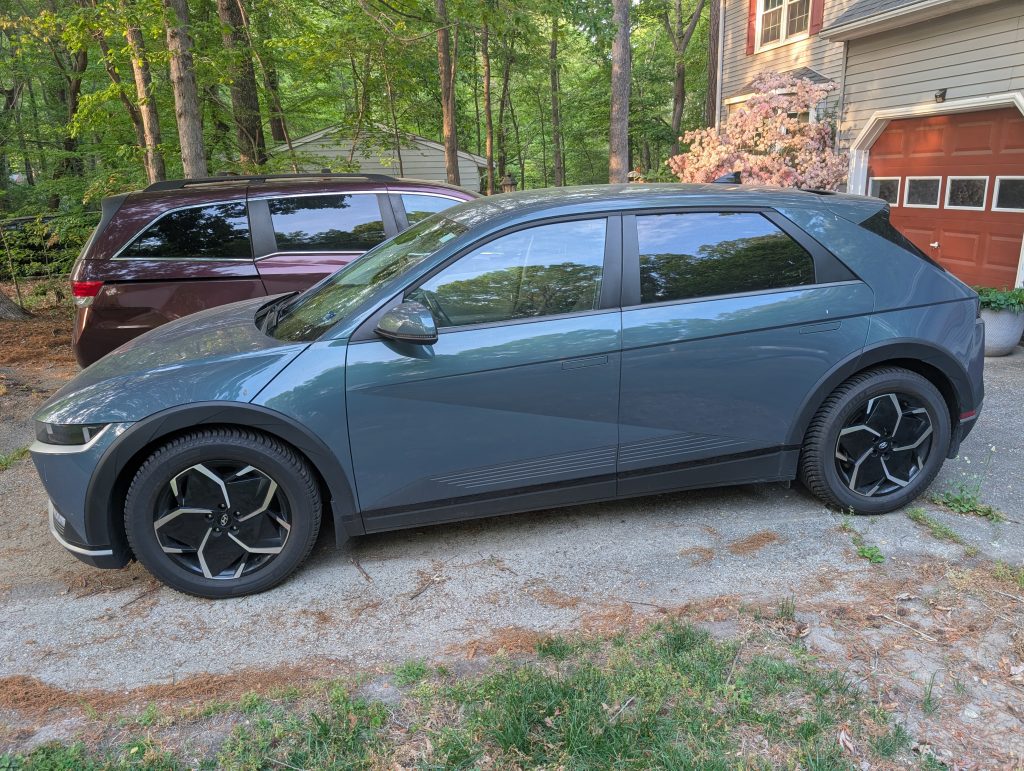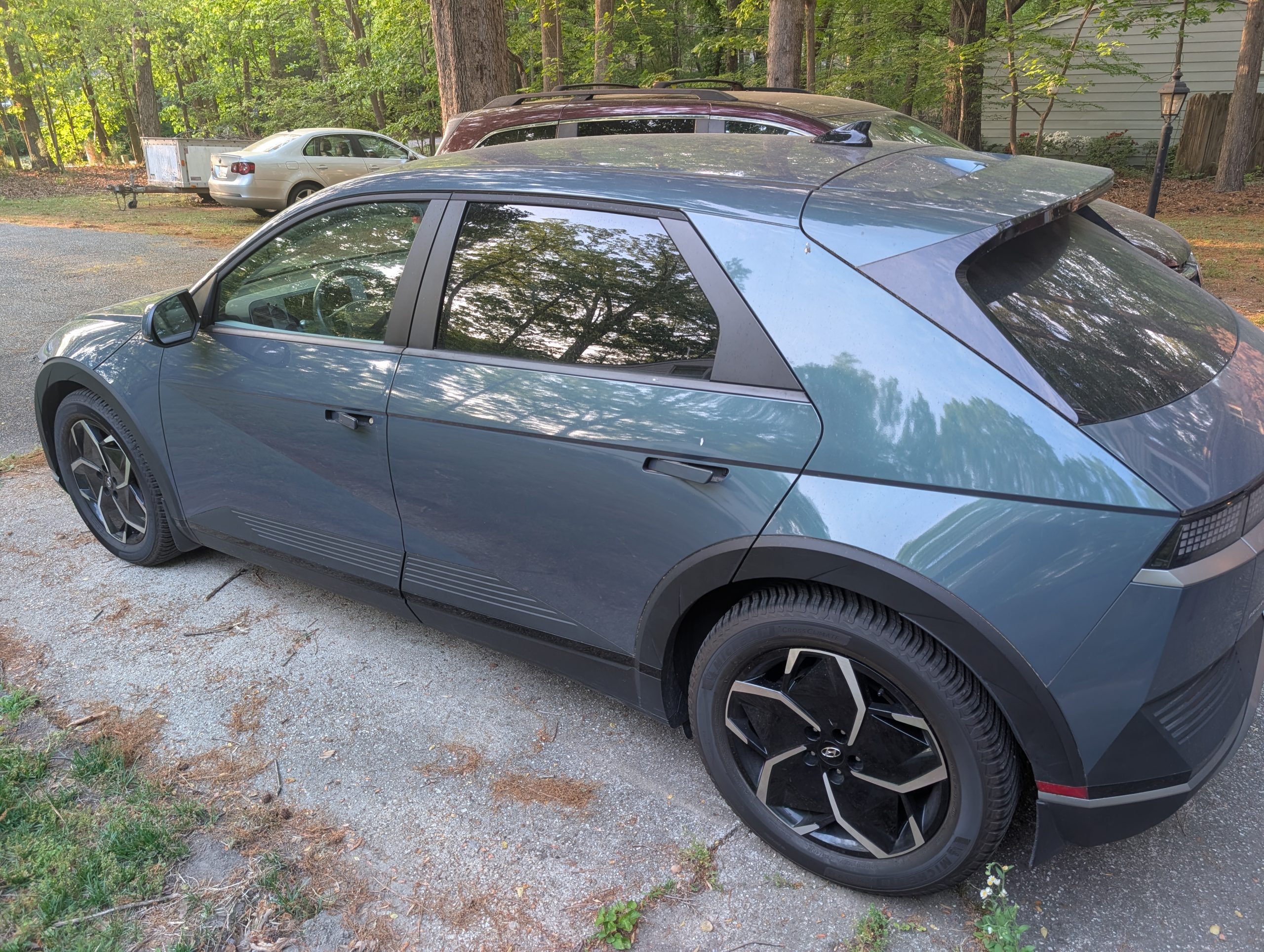
I purchased my 2022 Ioniq 5 SE AWD in April of 2022. I’ve driven it almost daily since then adding up to almost 40000 miles of travel at the time of writing in April 2026. This article will update my fuel and maintenance costs and capture some more general thoughts. It will give you one set of real world usage data for an electric vehicle. My experience may or may not be representative. There is a lot of variation in electricity pricing, some people have free charging at work or already had solar, and some people will live in an apartment without a good way to do home charging and have to regularly pay to commercially charge. YMMV!
This is the most recent of several articles on the car. They discuss my research, purchase, first long road trip, and experiences at the two year point of ownership::
- Two Years with my Ioniq 5 EV
- Buying my first EV
- My First Multi-State EV Roadtrip
- FAQ: Ioniq 5 Frequently Asked Questions answered
Fuel Cost Updates
I have continued to track every charge that I have added to the car in a Excel spreadsheet. The data lives on my Google drive so I can edit it at home or on my phone. I record start and end charging percentages, time charging, energy added, and charging cost. A few entries have been estimated when a free charger didn’t have a display screen. My home charger has a phone app that gives me all the data.
Virginia also has an EV usage tax that replaces the gas taxes that fund state road construction and maintenance. Most people pay the fee with their annual vehicle registration. I participate in the optional “Mileage Choice” program that spreads the fee out at a penny a mile, billed monthly, rather than being a lump sum. The total fee is capped at the annual fee amount and I typically come close but do not hit the cap. This tax is not included in my fuel cost charts.
So, let’s start with the big picture. I’ve driven about 39000 miles, using about 12000 kWh of electricity at a total cost of $1269 or an average cost per mile of 3.3 cents. I have charged almost 2/3 of the time at home and just over 1/3 of the time somewhere else including hotels, libraries, parking garages, and dedicated DC fast charging sites.
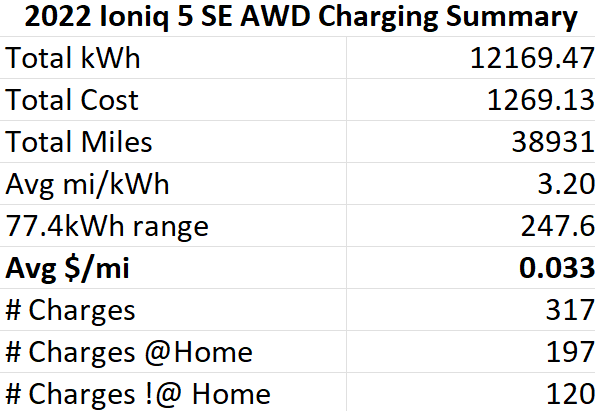
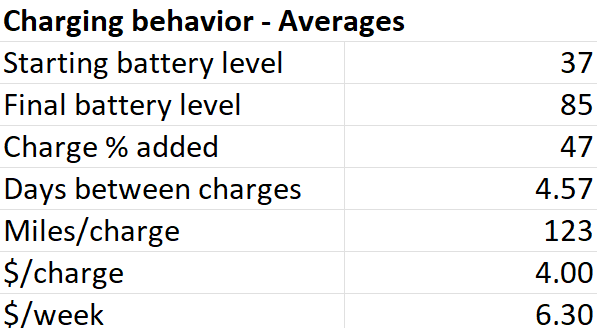
Getting into a little more detail, I have averaged using 8.6 kWh of electricity per day and spent $4 per charge or $6.30 per week. I have charged on average every 4.5 days which includes some long trips with several charges in a day and some times on non-driving travel where the car sat for a week or more unused.
That seems like I should be way ahead relative to fuel costs for a gas car. Well, maybe. I took a look at what gas would have cost for the same distance traveled in various vehicle types. I chose a $3.20 per gallon cost as an average price of gas over the time that I have owned the car. There is no real data or research behind this number other than seeming to me to be a reasonable value that includes the large fluctuations that we have seen it that time. With that made-up gas cost, I compared a generic 50mpg hybrid, a 25mpg sedan, and a 12mpg van or truck to get the following:
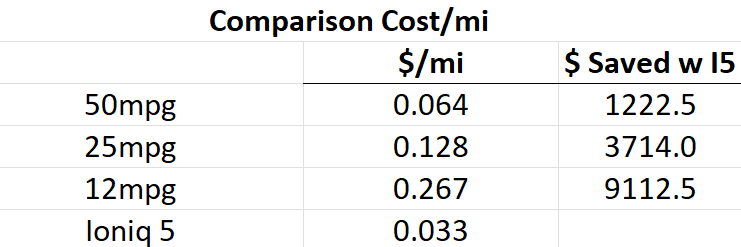
Even a gas-sipping hybrid costs about twice as much per mile for fuel and each other vehicle type doubles that cost again. But, that doesn’t save as much as you might think when compared to the vehicle purchase cost. I have saved just over $1200 versus a Prius-class vehicle – which would have perhaps been 10 times that less expensive to buy. So, the next chart computes the total odometer mileage required just to offset the difference in vehicle sticker prices for $5000, $10000, and $150000 in sticker difference.
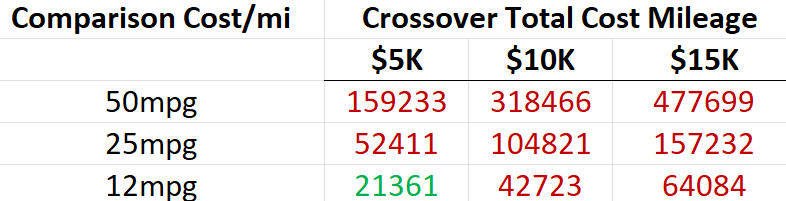
The green colors indicate where I have passed the cross-over point and the red where I have not. So far, I have only saved enough to make money on fuel costs when compared to a 12mpg vehicle that was $5000 less although I am very close to the $10000 less point. On the other hand, I would have to drive another 440,000 miles to offset the price difference for a Prius-type vehicle that was $15,000 less up front. At my current use of about 10,000 miles per year, I don’t think I or the car will live long enough to reach that crossover.
There definitely is a significant savings in fuel costs for electric vehicles if you can charge inexpensively or for free. And that, to me, easily makes the case for cars that are similar in price. But, if you expect to offset a substantial price difference, that could be a very long term pay off.
Maintenance Costs
Electric vehicles have fewer components compared to gasoline powered cars and require less maintenance. A big savings is not requiring oil changes. But, EVs are still cars that use windshield fluid and wipers, tires, etc. And they can have a few EV specific service requirements. I have added wiper fluid to the car several times, replaced both wiper blades twice, and the cabin air filter once. These items were $25 each or less.
My first semi-significant maintenance cost was self-installing a new AGM 12 volt battery at 21,500 miles at the cost of $125. In the last month, I replaced all four tires at Costco with a cost of $1250 (38000 miles). And, I had the dealer perform the scheduled battery coolant service at a cost of $560. Totaling up the trivial and significant, I have paid about $2150 in maintenance over the life of the car.
My perception is that this is less expensive than what one would have spent on a typical new gas car but I haven’t attempted to come up with any estimates of that cost or the relative savings.
Other Factors
There are lots of other factors that should be used to compare cars beyond sticker, fuel, and maintenance costs including quality, style, luxury, accessories, passenger and cargo volume, etc. My base model Ioniq 5 is significantly nicer than the 2007 base model Prius that it replaced. It has a lot more room for people and cargo and is much more comfortable and pleasant to drive on long trips. It also is more fun to drive with substantially better acceleration. A lot of these items are subjective but can have add real value to something that you are going use almost every day for many years.
Over the last 4 years the sticker price of many electric cars has come down to be more competitive with similar model gas cars. And the supply of used vehicles has increased as leased cars get turned in and resold. This makes the decision more one of personal preference than one where there is a clear financial advantage of one over the other.
Overall Feelings on the Car
I have been driving for more than 40 years and have owned a very wide variety of makes and models of cars. I typically purchase a car new, drive it for 7-14 years and donate it to charity when the repair costs exceed the remaining, small, value of the car. The Ioniq 5 has been the best, most fun, car that I have owned. It is also easily the most expensive. It was a leap of faith to spend the extra money while going to a full electric vehicle for the first time.
It took a short while to adapt to using an electric vehicle. But, I really do not miss regular stops at a gas station to pump my own gas. Now I can plug the car in at home and leave it for a few hours – typically while I am asleep. On trips I can plug it it, then head inside to use the facilities and buy a snack and drink and have the car finished when I come out since it can go from 20-80% charge in 18 minutes much of the time at a fast charger. We can frequently find hotels with free EV charging when we travel. New charging stations are being built at a rapid pace and I have adaptors that allow me to use almost any public charger (CCS, Telsa destination, or Tesla Supercharger). There are a variety of phone apps that help plan routes and check if chargers are in use so that waiting for a turn charging has been very much the exception for me.
See the My First Multi-State EV Roadtrip article for details on a long road trip experience of mine.
I hope this article will help you in your research for your next car and that you will try out and consider an electric vehicle.